
What Size Generator Do You Actually Need for a Foothill Home?

If you are on a well, the answer is probably bigger than you think, and the reason is a number most generator guides never mention.
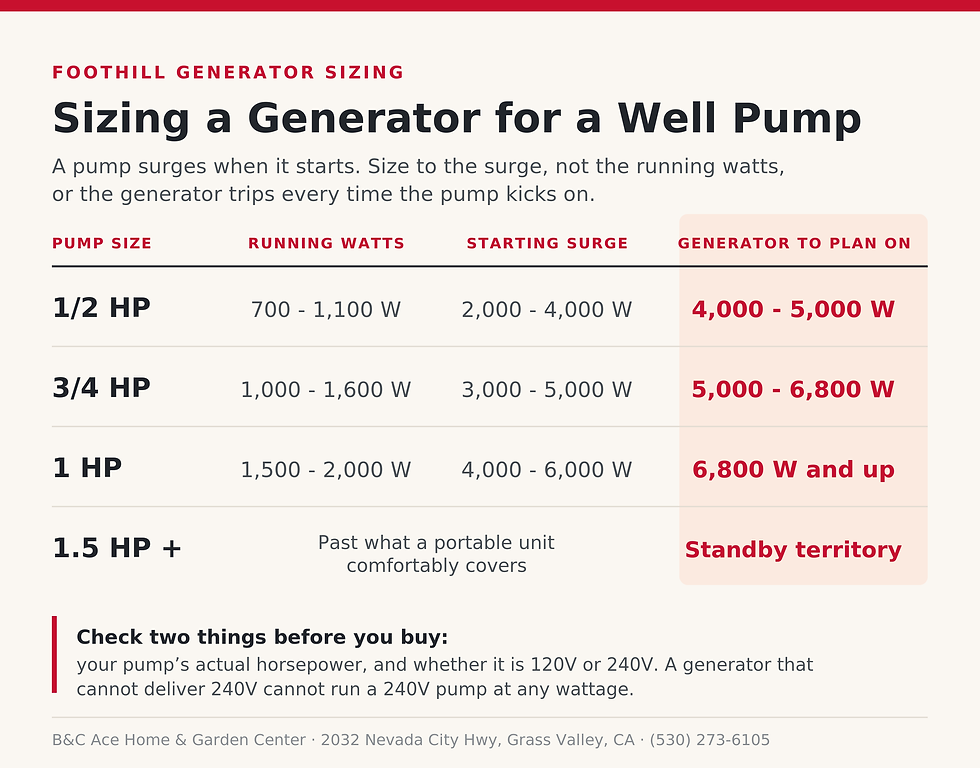
A submersible well pump does not draw its rated power when it starts. It surges. A half-horsepower pump that runs on roughly 700 to 1,100 watts can pull 2,000 to 4,000 watts for the second or two it takes to spin up. Size a generator to the running number and it will trip every time the pump kicks on, which means you spend a Public Safety Power Shutoff with working lights and no water.
That is the foothill version of this question, and it is not the version you will find in a guide written for a suburban house on city water.
Not sure what size you need? Bring your pump's horsepower to the counter.
Sizing is a five-minute conversation, and getting it wrong means a shutoff with lights and no water. We're at 2032 Nevada City Highway in Grass Valley, open 7:30 AM to 7:00 PM Monday through Saturday. Call (530) 273-6105 or browse generators in the Ace catalog and have it sent to the store.
If you are on a well, start there
For most homes around Grass Valley, Nevada City and Penn Valley, the well pump is the largest single load in the house and the one you least want to lose. Sizing the generator to the pump first, then adding what is left, gets you a working plan faster than adding up every light bulb.
Rough figures for common submersible pumps:
1/2 HP: about 700 to 1,100 running watts, 2,000 to 4,000 starting. Plan on a 4,000 to 5,000 watt generator at 240V.
3/4 HP: about 1,000 to 1,600 running, 3,000 to 5,000 starting. Plan on 5,000 to 6,800 watts.
1 HP: about 1,500 to 2,000 running, 4,000 to 6,000 starting. Plan on 6,800 watts and up.
1.5 HP and larger: you are past what a portable unit comfortably covers. This is standby territory.
Two things to check before you buy anything. First, your pump's actual horsepower, which is on the pressure tank paperwork or the well record rather than anywhere obvious. Second, whether it is 120V or 240V, because a generator that cannot deliver 240V cannot run a 240V pump at any wattage.
Add the surge, not just the run
The same rule applies to everything else with a motor in it. A refrigerator, a freezer, a furnace blower and a well pump all draw a spike at startup and settle to something much lower.
The practical method:
Write down the running watts of everything you actually need at once. Not everything you own.
Find the single largest starting surge in that list, which is almost always the well pump.
Add that one surge figure to the total running watts.
Add roughly 20% headroom on top so the generator is not pinned at maximum for days.
You do not add every appliance's surge together, because they do not all start at the same moment. You size for the worst single moment.
For a typical foothill house that means well pump, refrigerator, a freezer, some lights, and the furnace blower if it is winter. That lands most people between 5,000 and 7,500 watts. Running the whole house including electric range and air conditioning is a different conversation and usually a standby unit.
Three tiers, and who each one is honestly for
Battery power stations, roughly 300 to 1,000 watts. These run a laptop, a router, phones, a CPAP and some lights. They are silent, they work indoors safely, and they recharge from solar. What they will not do is run a well pump. For a short shutoff where you mostly need to stay connected and keep a medical device going, they are the least hassle in this list. The Ace catalog carries EcoFlow and EGO in this range.
Portable generators, roughly 3,000 to 9,500 watts. This is where most foothill households land. Enough for a well pump plus a refrigerator plus the essentials, they store in a shed between uses, and they cost a fraction of a standby install. The trade is that you start them yourself, you refuel them yourself, and they must live outside while running. Champion, Craftsman and Generac all sit in this tier.
Standby generators, 14kW and up. Permanently installed, wired to a transfer switch, and they start themselves when the power drops. If you are gone for stretches, if someone in the house depends on power for medical reasons, or if shutoffs regularly run past a day, the automatic part is the whole value. It is a real electrical job and a permit, not a weekend purchase.
Be honest about which of those you are. A lot of people buy the portable and wish they had gone standby after their third multi-day shutoff. A lot of other people buy far more generator than a once-a-year outage justifies.
Gas, propane, or dual fuel
Gasoline is the cheapest per watt and the easiest to find, right up until the outage is regional and every station within thirty miles is also without power. Stored gas also goes stale in a few months, so a can in the shed from last October is not a plan.
Propane keeps indefinitely. A tank you filled two years ago starts a generator today, which for an event you cannot schedule is the whole argument. It burns a little less efficiently, so you get somewhat fewer hours per gallon-equivalent than gasoline.
Dual fuel is the sensible default here, because it lets you run on whichever one you actually have when the power goes out.
One local caveat worth planning around. We do propane exchange, not fill-by-the-gallon, so the way to be ready is to have spare tanks rather than expecting to top one off during an emergency. A 20 lb tank runs a mid-size generator in the range of five to eight hours depending on load, so a multi-day shutoff on 20 lb tanks means a stack of them. If propane is your primary fuel, the larger tanks are worth it. We carry new empty tanks in 11, 20, 30, 40 and 100 lb, and a 20 lb exchange is $24.99.
The part that is not optional

Carbon monoxide from a portable generator kills roughly a hundred people a year in the United States, and it does it fast. The Consumer Product Safety Commission puts it plainly: one generator produces as much carbon monoxide as hundreds of cars, and it can incapacitate and kill within minutes.
The rules are short and there is no clever version of them.
Never run a generator inside a home, garage, basement, crawlspace or shed. Not with the door open. A garage with the door up is still a partly enclosed space and people die in them every year.
Keep it outside and well away from windows, doors and vents, including your neighbor's.
Have a working carbon monoxide alarm in the house. If you own a generator and do not own a CO alarm, buy the alarm first.
Never plug a generator into a wall outlet to power the house. That pushes current back down the line and can kill a utility worker restoring your power. Powering circuits properly means a transfer switch installed by an electrician.
If you take one thing from this section, make it the alarm.
Generator FAQs
What size generator do I need to run a well pump? It depends on the pump's horsepower and its starting surge, not its running watts. A 1/2 HP pump generally needs a 4,000 to 5,000 watt generator, a 3/4 HP pump needs 5,000 to 6,800 watts, and a 1 HP pump needs 6,800 watts or more. Confirm whether your pump is 120V or 240V before buying.
How long will a 20 lb propane tank run a generator? Roughly five to eight hours on a mid-size unit, depending on load. Plan on multiple tanks for a multi-day shutoff, or step up to a larger tank size.
Can I run a generator in my garage with the door open? No. The CPSC prohibits generator use in garages, basements, crawlspaces and sheds regardless of ventilation. A partly enclosed space is still enclosed.
Portable or standby for a PSPS? A portable covers a well pump and essentials for a fraction of the cost and suits occasional shutoffs. A standby starts itself and runs the house, which matters if shutoffs regularly last more than a day, if anyone at home depends on powered medical equipment, or if the property is sometimes empty.
Do I need a transfer switch? For anything wired into your home's circuits, yes, and it needs a licensed electrician. Running appliances directly off extension cords from the generator does not.
What about a battery power station instead? Good for phones, internet, lights and a CPAP, and safe to use indoors. Not enough for a well pump.
Come talk it through
Sizing is the part worth getting right, and it is a five-minute conversation at the counter with your pump's horsepower in hand.
B&C Ace Home & Garden Center
2032 Nevada City Highway, Grass Valley, CA 95945
(530) 273-6105
Monday through Saturday 7:30 AM to 7:00 PM, Sunday 8:00 AM to 5:00 PM
Browse generators in the Ace catalog and have it sent to the store, or call us and we will help you work out the size before you order. While you are getting ready, our propane tank exchange is the easy way to keep spare fuel on hand, and the Grass Valley fall and winter checklist covers the rest of what people forget until the first cold night.
Carbon monoxide guidance from the U.S. Consumer Product Safety Commission. Annual generator CO death estimate via PIRG. For current shutoff maps and outage alerts for your address, PG&E's Public Safety Power Shutoff page is the authoritative source.


Comments